Bringing Push Notifications to Raccoon
Published on May 20, 2026
The Beginning: a Missing Feature
One of the most common complaints during Raccoon's first year of development, and a major reason why some early adopters jumped ship, was the lack of support for push notifications.
It's a fair critique, but what many users didn't realize is that push notifications aren't just a simple, client-side switch you flip. As the name suggests, notifications must be "pushed" to devices by an external service the moment an event occurs.
To understand why this was such a hurdle for Raccoon, we first need to look at how traditional push notifications work.
Anatomy of Push Notifications
The standard architecture for push notifications is a three-way dance involving the client device, the backend instance, and a third-party messaging relay acting as the "man in the middle".
Here is how they interact:
-
Client Application: the app registers with a third-party messaging service—usually tied directly to the mobile operating system, like APNS for iOS or FCM for Android. The device obtains a unique "push token" for that specific app installation and sends it to the backend via an authenticated endpoint.
-
Application server: the backend stores these tokens and links them to the correct user account. Whenever an event triggers a notification (based on the user's preferences), the backend makes a server-to-server call to the messaging relay.
-
Messaging Relay: this service takes the backend's request and dispatches the message to the device on a "best-effort" basis (handling edge cases like offline devices, app badges, priority levels, custom sounds, etc.).
In short: the client app handles tokens and incoming messages, the application server manages user preferences and triggers, and the messaging service handles the complex, platform-specific delivery.
The Open Source Dilemma
While this architecture works flawlessly for centralized corporate apps, the rules change entirely when you build for open-source networks and the Fediverse.
Raccoon has been strongly committed to zero reliance on closed-source, proprietary third-party libraries, otherwise I would not even be able to distribute the app through F-Droid. That immediately rules out standard integrations with FCM and APNS.
Then, I discovered UnifiedPush.
Decoupling the "Man in the Middle"
UnifiedPush is based on a slightly different paradigm. Instead of a single, proprietary monolith, it splits the middleman into two separate components:
- Push Server: it receives events directly from the application server through the WebPush open protocol;1
- Distributor: an app installed on the device which delivers those notifications to individual apps through the UP protocol.
So, together with the application server and the client app, there are totally four components involved:
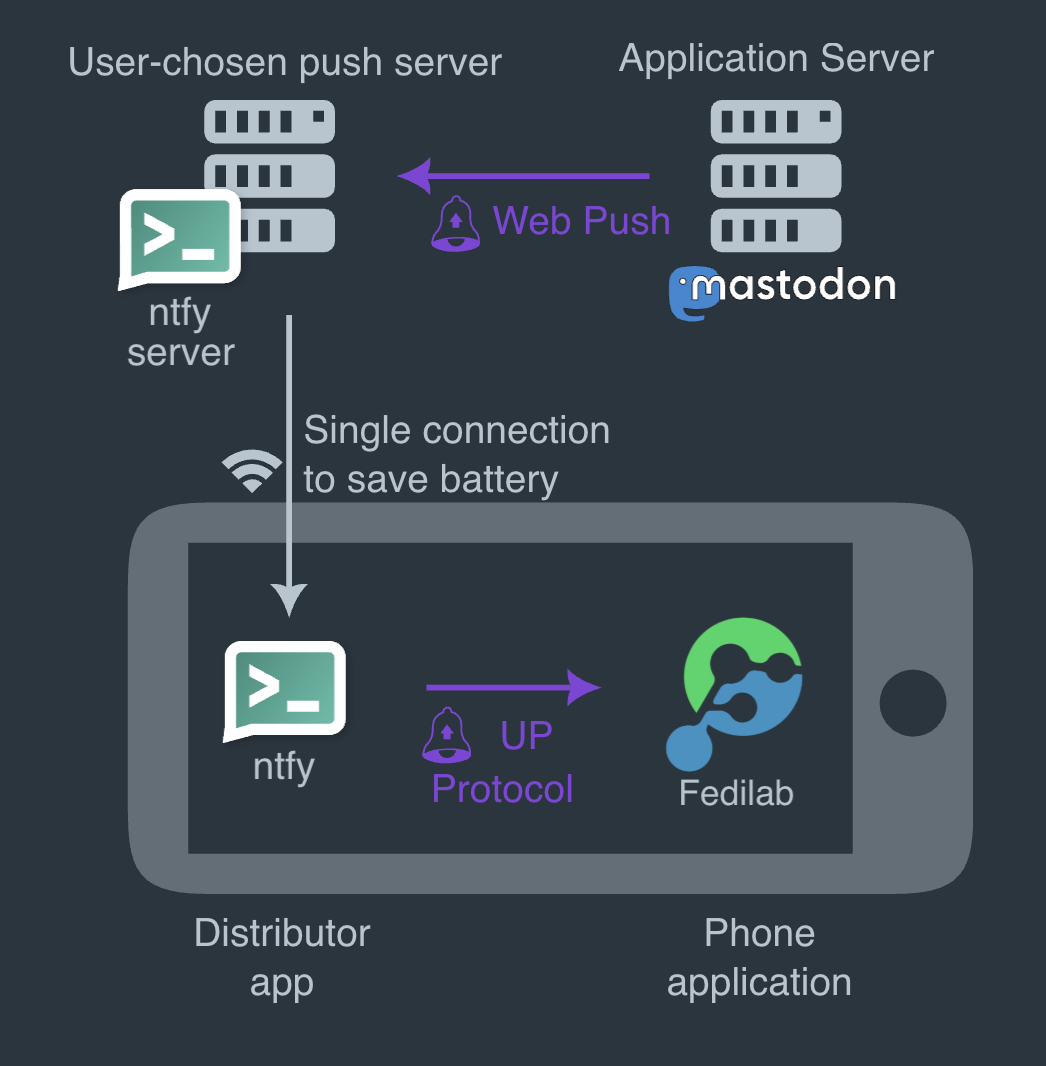
In this scenario, the client app registers in onto the distributor. The latter contacts the push server to create an endpoint. Once obtained, the endpoint is delivered back to the client app, which transmits it to the application server which stores the endpoint data associated to the user.
When a notification needs to be sent, the application server sends a message to the endpoint it has stored, which points to the push server. The push server processes the message and the distributor, which is subscribed for messages on the push server, proxies the notifications to the client app.
Decoupling the push server and the distributor allows for more flexibility: you are free to use whatever technology best suits you. E.g. on the server side you can choose a self-hosted server like ntfy.sh or NextPush which integrates with NextCloud, SunUp, etc. whereas on the client-side you can use the their counterparts of ntfy and SunUp on Android or dedicated apps (e.g. KUnifiedPush on Linux).
The Breakthrough: Friendica Notifications
Implementing this on Android turned out to be a game-changer. Thanks to the UnifiedPush Android SDK, Raccoon can seamlessly configure distributors, detect when new ones are installed, and let the user choose their preferred routing.
Recommendation
If you are setting this up on Android, I highly recommend using Sunup as your distributor. It is incredibly easy to set up and completely frictionless to use.
The result?
Finally, fully working, privacy-respecting push notifications! With this major milestone ticked off the list, there's officially one excuse less to prefer other Fediverse clients. 😂 🦝
References
- Official UnifiedPush website
- Guida a UnifiedPush su Mastodon, Matrix e Telegram
- UnifiedPush: notifiche push decentralizzate e open source
-
If the target platform's server is not directly compatible, Push Gateways are available too. ↩